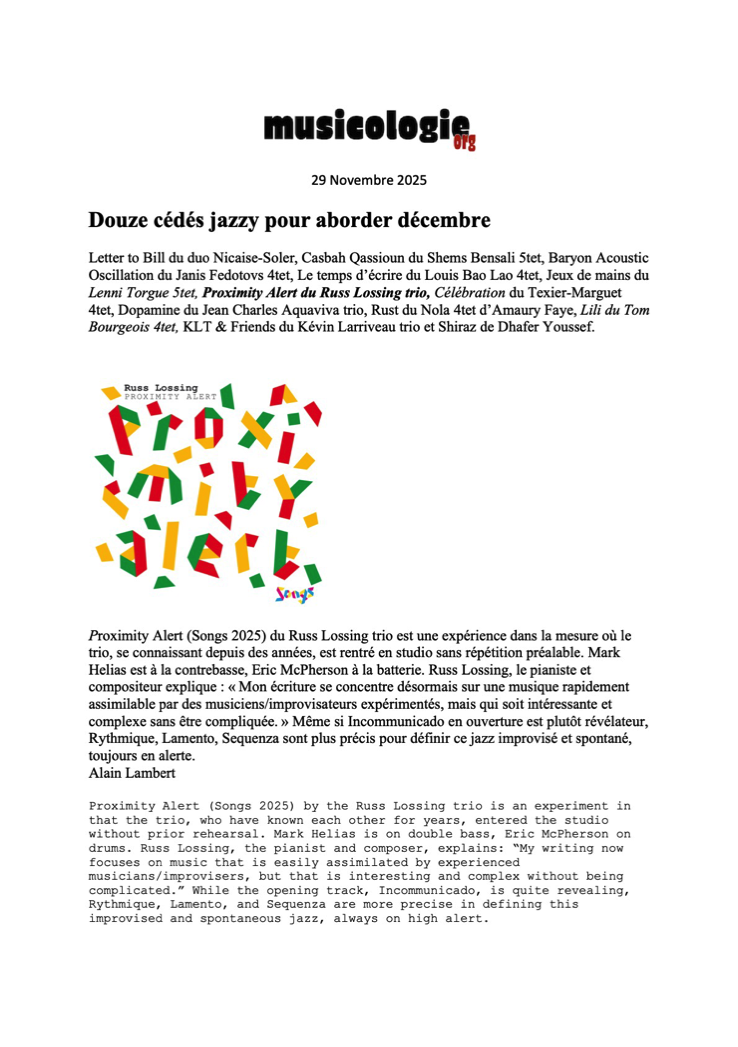
Proximity Alert Reviews
Richard Kamins
Several years a go, I had the opportunity to interview pianist ad composer Russ Lossing upon the release of his 2023 recording, “Alternate Side Parking Music” (SONGS Records). Not only is he a fine pianist but has a wicked sense of humor. Like the late pianist Frank Kimbrough, Lossing enjoys going into a recording without compositions or rehearsals but betting on the relationships he has with creative musicians to create emotionally-rich music.
“Proximity Alert” (SONGS) was released in November. The trio includes Lossing, bassist Mark Helias, and drummer Eric McPherson. Over the course of 11 songs and 62 minutes, the musicians challenge each other, support, listen closely, interacting and playing with glee, fire, and intelligence.
As with the recordings above, “Proximity Alert” is not background music. These are sounds to savor, to ponder, to make you smile, and to feel safe in the warmth of creative artists!
Ferdinand Dupuis-Panther
English Translation:
The album opens with "Incommunicado": The trio confronts us with a bang, even though there is no actual timpani roll. What we experience is dynamics, sonic fire, pulsating rhythms shaped by the bassist and drummer, no stillness, and charged energy in the keyboard playing. Figuratively speaking, it's like a sonic tornado sweeping across an arid landscape. Listening to Russ Lossing, one experiences a kind of primal force that knows few bounds, and this holds true until the very last bar. In the following track, "Boo-Da," one might think one is hearing classical Russian composers, at least playing along in spirit. There is pathos to be experienced, as well as expansive sonic arcs. What we hear seems suitable as a partial soundtrack to a silent film about an extended train journey. Rolling landscapes drift by, the clatter of the locomotive can be heard, and cloud formations float by. The pianist orchestrates all of this with nimble fingers, accompanied by the drummer's intense rhythmic rustling and dark bass lines.
As the fourth track, the musicians perform the album title: "Proximity Alert." The pianist presents us with "jumping patterns." Following the pianist's playing, one might think a horse race with hurdles is being simulated sonically. The bassist's lively solo is particularly noteworthy; while it may not exactly convey a horse race in sonic sequences, perhaps it evokes an exciting hurdle race, right? Subsequently, sonic turbulence reaches our ears. Order seems to have been thrown out of joint, although the pianist occasionally drives in sonic "stakes" to give the piece form and foundation.
Next, we hear "Emphasis My Own." This piece certainly breathes the spirit of classical music, as found in the works of well-known Russian composers. This is primarily due to the trio's pianist, who is occasionally accompanied by a powerful bass. When this occurs, the bassist and pianist form a kind of sonic helix in their playing. Russ Lossing occasionally ventures into the treble, immersing himself in embellishments that, figuratively speaking, evoke bubbling springs. In short, this piece, like others, celebrates a world theater, much like Max Beckmann did in his expressive paintings. The musicians combine drama and dramatic intensity in a rich and dense soundscape.
The album also features a piece titled "Lamento." The tempo is moderate, driven primarily by Russ Lossing. The piece has a somewhat sacred feel, like a lament with which the deceased embarks on their final journey. This piece, too, is not without grand gestures, is it? Contemplation merges with serenity. Bass and percussion seem more like accompaniments. The piano takes center stage. Two more tracks from the eleven-track album deserve further mention: "Snowy Night" and "Silent Alarm," both found at the end. Let's begin with "Snowy Night": The music captures the tranquility of the night, perhaps even focusing on night owls trudging home through the snow. And in the treble, Russ Lossing seems to be capturing the snowflakes drifting down from the sky, doesn't he? The pianist's elaborate playing conveys a sense of slowed-down daily life. The album concludes with "Silent Alarm": The three musicians capture unease and excitement in their "audio piece." There's a constant back and forth, as if people are running around frantically, unaware of what's happening. The drama builds from moment to moment as the listener follows the piece. However, the listener doesn't experience reassurance. On the contrary, the piano passages suggest that the danger is far from over. The alarm signal is anything but inconspicuous, as the title of the play might suggest. The threatening situation doesn't change until the very end of the play, does it?
Original in German:
Die Eröffnung des Albums lautet „Incommunicado“: Gleichsam mit einem Paukenschlag konfrontiert uns das Trio, auch wenn auf einen Paukenschlag verzichtet wird. Dynamik, Klangfeuer, pulsierende Rhythmik, durch den Bassisten und Drummer gestaltet, keinen Stillstand und aufgeladene Energie im Tastenspiel ist das, was wir erleben. Bildlich gesprochen gleicht das einer klanglichen Windhose, die durch eine aride Landschaft fegt. Man erlebt eine Art von Urgewalt, die wenig Grenzen kennt, lauscht man Russ Lossing, Und das gilt bis zum letzten Takt. Bei dem nachfolgenden Stück „Boo-Da“ meint man, man höre auch klassische russische Komponisten, jedenfalls im Geiste mitspielend. Da gibt es Pathos zu erleben und auch große Klangbögen. Geeignet scheint das, was wir hören, als teilweise Untermalung eines Stummfilms über eine ausgedehnte Eisenbahnfahrt. Wellige Landschaften ziehen vorbei, das Rattern der Lok ist zu vernehmen, Wolkenbilder schweben dahin. All das inszeniert der Pianist mit flinken Fingern, begleitet von intensivem „Rhythmik-Geraschel“ des Drummers und von dunklen Bassmustern.
Als vierten Track tragen die Musiker den Albumtitel vor: „Proximity Alert“. „Sprungmuster“ präsentiert uns der Pianist. Man meint, klanglich werde ein Pferderennen mit Hindernissen simuliert, folgt man dem Spielzyklus des Pianisten. Sehr hörenswert ist das quicklebendige Solo des Bassisten, der vielleicht nicht gerade ein Pferderennen in Klangsequenzen vermittelt, aber vielleicht ein spannendes Hürdenrennen, oder? Im Weiteren dringen Klangturbulenzen an unsere Ohren. Da scheint die Ordnung aus den Fugen geraten zu sein, obgleich der Pianist hier und da „Klangpflöcke“ einrammt, um dem Stück Form und Fundament zu geben.
Nachfolgend hören wir „Emphasis My Own“. Dieses Stück atmet durchaus den Geist klassischer Musik, wie er sich bei bekannten russischen Komponisten findet. Das ist vor allem dem Pianisten des Trios geschuldet, der zeitweilig von einem starken Bass begleitet wird. Wenn das der Fall ist, formen Bassist und Pianist in ihrem Spiel eine Form einer Klang-Helix. Russ Lossing bewegt sich zeitweilig im Diskant, vertieft sich in Umspielungen, die bildlich gesprochen an sprudelnde Quellen erinnern. Kurz: Auch in diesem Stück wird wie in anderen Weltentheater zelebriert, und zwar so, wie es Max Beckmann in seinen expressiven Gemälden getan hat. Drama und Dramatik vereinen die Musiker in klanglicher Dichte.
„Lamento“ heißt es außerdem auf dem Album: Gemäßigt ist das Tempo des Stücks, geprägt vor allem von Russ Lossing. Ein wenig nach sakraler Musik mutet das Stück an, nach einem Trauer- und Klagelied, mit dem der Verstorbene seine letzte Reise antritt. Auch dieses Stück kommt nicht ohne große Gesten aus, oder? Besinnung vereint sich mit Besinnlichkeit. Bass und Schlagwerk scheinen eher Beigabe. Im Fokus steht das Piano. Zwei weitere Titel aus den insgesamt elf Tracks sollen im Nachgang noch angesprochen werden „Snowy Night“ und „Silent Alarm“, die beide am Ende des Albums zu finden sind. Beginnen wir mit der „Verschneiten Nacht“: Nächtliche Ruhe wird eingefangen, vielleicht auch auch der Blick auf die Nachtschwärmer gerichtet, die durch den Schnee nach Hause stapfen. Und im Diskant scheint Russ Lossing die vom Himmel schwebenden Schneeflocken einzufangen, oder? Verlangsamt ist der Alltag, so signalisiert es der Pianist mit seinem elaborierten Spiel. Den Schlusspunkt des Albums bildet das Stück „Stiller Alarm“: Unruhe und Aufregung fangen die drei Musiker in ihrem „Hör-Spiel“ ein. Da vernimmt man ein Hin und ein Her, so als laufen Menschen aufgeregt durcheinander, nicht ahnend, was gerade passiert. Die angelegte Dramatik steigert sich von Moment zu Moment, folgt man dem Stück. Dabei erlebt der Hörer nicht etwa Beruhigung. Nein, die Piano-Passagen deuten eher daraufhin, dass die Gefahr nicht gebannt ist. Die Alarmaussendung scheint keineswegs unauffällig, wie man dem Titel des Stücks entnehmen könnte. Die bedrohliche Situation verändert sich nicht bis zum Ende des Stücks, oder?
All About Jazz
By Mark Corroto
October 27, 2025
Russ Lossing: Proximity Alert
Is Russ Lossing's Proximity Alert more like football or baseball? The analogy works like this: Baseball is fathers and sons tossing a ball in the backyard, measured and casual; Football is a scrimmage, brothers running, grappling and tackling in the same yard.
Throughout his career, Lossing has captained several exceptional trios. With bassist Ed Schuller, he had the rare honor of performing and recording alongside the legendary drummer Paul Motian. In the years that followed, he formed groups with Billy Mintz and Masa Kamaguchi, as well as with bassist John Hébert and a rotation of drummers including Jeff Williams, Adam Kolker and Michael Sarin. His time with Motian, in particular, shaped his appetite for the rough-and-tumble—music that balances discipline with in-the-moment spontaneity. Like a great football team, this approach thrives on structure but leaves room for improvisational sparks.
Proximity Alert is Lossing's second trio outing with bassist Mark Helias and drummer Eric McPherson, following Mood Swing (SteepleChase, 2020). From the opening moments, the music takes on a gridiron energy that sustains throughout the recording. On "Incommunicado," the trio pushes and pulls in shifting directions and tempos, their romping intensity held together by an underlying discipline. "Boo-Da" has the feel of players scrapping on different levels, yet the precision of their interplay makes it sound like the work of a finely-drilled unit. The title track and "Sequenza" best capture the sense of a backyard ruckus—forceful, spirited, but tightly executed.
The album also shows its 'inside baseball' moments. "Emphasis My Own" and "Apostrophe" are abstract explorations that depend on each musician's sharp focus and responsiveness to Lossing's compositions. In this setting, the metaphorical ball never touches the ground. The trio brings the same attentiveness to gentler pieces like the ballad "Lamento" and the brisk bebop-tinged "Rhythmique." The lone group improvisation, "Silent Alarm," connects directly to Lossing's recent solo piano release, Inventions (A Suite of Improvisations) (Songs, 2024), highlighting his ongoing fascination with spontaneous composition.
Ultimately, Proximity Alert thrives on the energy of collective play. One can practice alone—at the batting cages or kicking field goals—but the backyard games are always more satisfying. That spirit of camaraderie and collision, of discipline sharpened by risk, is what makes this trio's music both vital and alive.
Track Listing
Incommunicado; Boo-Da; Apostrophe; Proximity Alert; Empasis My Own; Rhythmique; Lamento; Sequenza; Relentless; Snowy Night; Silent Alarm.
Jazz Journal. Nov. 10, 2025
Reviewed: Russ Lossing
By Nic Jones
Russ Lossing: Proximity Alert (Blaser Music Songs 003CD)
Russ Lossing: Proximity Alert (Blaser Music Songs 003CD)
Pianist Lossing is on this basis working in areas outside the conventional finger-busting that the line-up of piano, bass and drums might be historically associated with. In this third decade of the 21st century, and in view of approximately a century of jazz on record, this is no bad thing.
Lossing's vision is dependent on empathetic accompaniment, and in bass player Mark Helias and drummer Eric McPherson he has partners who are right on the money in terms of realising the music. This is nowhere more apparent than on Boo-Da, where the compositional demands are met with aplomb and there's not a moment of doubt when it comes to offbeat musical coherence. The surface activity, periodically manifested in the contributions of all three musicians, belies the underlying rigour, which keeps the music from descending into incoherence.
Snowy Night, a title not without visual implications, bridges the divide between the heard and the seen with a sense of uncontrived mystery. In some hands this might descend into something similar to the ECM label's by now very well-established take on atmosphere, but in this case the music takes account of titular implications and doesn't lay back to the point where either atmosphere or some facile notion of beauty become ends in themselves.
The trio improvisation Silent Alarm is the last track and such is its placing that listeners are afforded a tantalising glimpse of what this trio's capable of when happenings in passing moments are left to chance. The music is kind of unassuming in the sense that there's no overt attempt at grabbing listeners' attention, and is all the more compelling because of this.
Les Dernières Nouvelles du Jazz (The Latest Jazz News), by Xavier Prévost .
Russ Lossing (piano), Mark Helias (contrebasse), Eric McPherson (batterie)
South Orange (New Jersey), 3 avril 2024
Songs 003CD / l'autre distribution
C'est la deuxième rencontre phonographique entre ces trois musiciens (après 'Mood Suite', Steeple Chase, publié en 2020) . Le pianiste propose une sorte de manifeste de la liberté interactive, où sa proposition pianistique entraîne une sorte de réaction en chaîne dont surgit, pas à pas, et de plus en plus lisible, une forme. C'est notamment très flagrant dès la première plage, Incommunicado . C'est un perpétuel jouage, si l'on peut proposer, comme le font bien des artistes de jazz francophones, cet équivalent à l'interprlay . La qualité et la créativité de la musique reposent à la fois sur les ressources musicales et instrumentales de chacun des protagonistes (et ici l'on est au plus haut niveau) et sur l'adhésion à un principe d'aventure commune où l'on s'engage sans réserve. Il en résulte une prestation de très haut vol, où les surprises fusent, et nous paraissent pourtant obéir à une parfaite logique : Conception ? Réactivité ? Réflexe ou imagination en perpétuel éveil ? En tout cas le résultat est un pur régal des sens et de l'esprit. Grand disque de trio, libre et conduit vers une exigence de beauté singulière : exigence assumée, et même sublimée. Bravo !
Xavier Prévost
English Translation:
This is the second phonographic encounter between these three musicians (after Mood Suite, Steeple Chase, published in 2020). The pianist offers a kind of manifesto of interactive freedom, where his pianistic proposition triggers a sort of chain reaction from which a form emerges, step by step, and with increasing clarity. This is particularly striking from the very first track, Incommunicado. It is a perpetual act of play — "jouage," if one may borrow the term, as many French-speaking jazz artists do, as their equivalent of "interplay." The quality and creativity of the music rest both on the musical and instrumental resources of each of the protagonists (and here we are at the highest level) and on a shared commitment to a spirit of common adventure, entered into without reservation. The result is a performance of the very highest order, where surprises fly thick and fast, yet seem to obey a perfect logic: Conception? Reactivity? Reflex, or imagination in a state of perpetual alertness? In any case the result is a pure delight for the senses and the mind. A great trio record, free and guided toward a singular demand for beauty — a demand fully embraced, and even sublimated. Bravo!
— Xavier Prévost
Citizen Jazz. Oct 12, 2025
Un an après un enregistrement solo justement remarqué dans , Russ Lossing revient avec un nouveau trio. Également signé sur Songs, le label de Samuel Blaser, l'Américain s'entoure de personnalités qui lui permettent de porter ailleurs sa pratique pianistique tout en restant dans le prolongement de deux de ses trios fondateurs, ceux au côté de Ed Schuller et Paul Motian ou encore de Masa Kamaguchi et Billy Mintz.
Si le jeu de Lossing reste toujours à la fois tonique et solidement architecturé, c'est parfaitement installé sur ces assises et porté par une technique maîtrisée qu'il peut s'aventurer dans des pièces anguleuses avec un enthousiasme jamais démenti. Soutenu par la basse épaisse de Mark Helias qui se plie facilement à cet univers – et pour cause, elle y est à son aise - en fermant les angles ouverts par le pianiste, le trio profite d'un supplément de fluidité avec la batterie de Eric McPherson. Au premier abord d'une approche plus conventionnelle que celles de Motian ou Mintz, il joue en fond de court avec une gestuelle sur les fûts qui arrondit les propositions de ses partenaires.
De ces trois personnalités se dégage ainsi un naturel qui contraste avec leurs compositions alambiquées. Avec un sens du rebond et de la circulation des intentions, les trois s'élancent dans des structures tortueuses qu'ils investissent avec gourmandise, n'hésitant pas, preuve de leur décontraction, à s'engager dans des passages au swing roboratif. On entend là un amour jamais démenti pour cette musique malgré une longue pratique. A l'autre bout de ce large panel, des pièces plus introspectives, délicates dans leur interprétation, sont l'expression d'une envie de ne pas chercher la virtuosité systématique mais plutôt, tout simplement, de faire musique en partageant des émotions variées toujours authentiques.
par Nicolas Dourlhés// Publié le 12 octobre 2025
A year after a solo recording that was rightly noted in our pages, Russ Lossing returns with a new trio. Also released on Songs, Samuel Blaser's label, the American surrounds himself with personalities that allow him to take his pianistic practice somewhere new, while remaining in the tradition of two of his founding trios — those alongside Ed Schuller and Paul Motian, and Masa Kamaguchi and Billy Mintz.
While Lossing's playing remains both energetic and solidly architectural, it is precisely from this firm foundation, and carried by a mastered technique, that he can venture into angular pieces with an enthusiasm that never wavers. Supported by the thick bass of Mark Helias — who bends easily to this world, and with good reason, since he is right at home in it — closing the open angles left by the pianist, the trio benefits from an added fluidity through the drumming of Eric McPherson. At first glance taking a more conventional approach than those of Motian or Mintz, he plays deep in the court with a gestural quality on the drums that rounds off his partners' propositions.
From these three personalities emerges a naturalness that contrasts with their intricate compositions. With a sense of bounce and of circulating intentions, the three launch themselves into tortuous structures that they inhabit with relish, not hesitating — proof of their ease — to engage in passages of invigorating swing. One hears there an undying love for this music despite long practice. At the other end of this wide range, more introspective pieces, delicate in their interpretation, express a desire not to pursue systematic virtuosity but rather, quite simply, to make music by sharing varied emotions that are always authentic.
— Nicolas Dourlhès, published October 12, 2025
Culture Jazz
Dec 3, 2025
By Yves Dorison
RUSS LOSSING . Proximity alert
Avec ce nouveau disque, le trio de Russ Lossing, accompagné par les fidèles Mark Hélias à la contrebasse et Eric McPherson à la batterie, enfonce un peu plus le clou. Entrés en studio sans avoir répéter quoi que ce soit, ils se sont fait confiance et, avec les qualités intrinsèques qu'on leur connait, ils ont fait beau voyage qu'ils partagent avec nous. On les remercie donc, d'autant plus que leur univers musical ne manque de points d'accroche pour nous séduire. La dynamique de leur musique est spéciale, elle offre à l'auditeur une complexité jamais barbante, toujours lisible, faite de surprises rythmant le cours d'un discours savant et captivant. Chacun des musiciens apporte son savoir-faire autant que son savoir-être. Le cumul de leurs talents respectifs forme un triangle musical parfait qui les place sur le haut du panier ; sachant quelle est la concurrence sur le secteur, cela vous donne une idée de la qualité de cet enregistrement. C'est vif, inspiré, précis et fin. Que voulez-vous qu'on vous de plus sinon de l'acheter ?
English Translation:
With this new record, Russ Lossing's trio, accompanied by the faithful Mark Helias on double bass and Eric McPherson on drums, drives the nail in a little further. Having entered the studio without having rehearsed anything at all, they trusted one another and, with the intrinsic qualities we know them for, they made a fine journey that they share with us. We thank them for it — all the more so because their musical world has no shortage of hooks to win us over. The dynamic of their music is something special: it offers the listener a complexity that is never boring, always readable, full of surprises that punctuate the flow of a learned and captivating discourse. Each musician brings his know-how as much as his way of being. The sum of their respective talents forms a perfect musical triangle that places them at the top of the pile — and knowing the level of competition in this field, that gives you some idea of the quality of this recording. It is lively, inspired, precise and refined. What more do you want us to tell you, other than to go and buy it?